
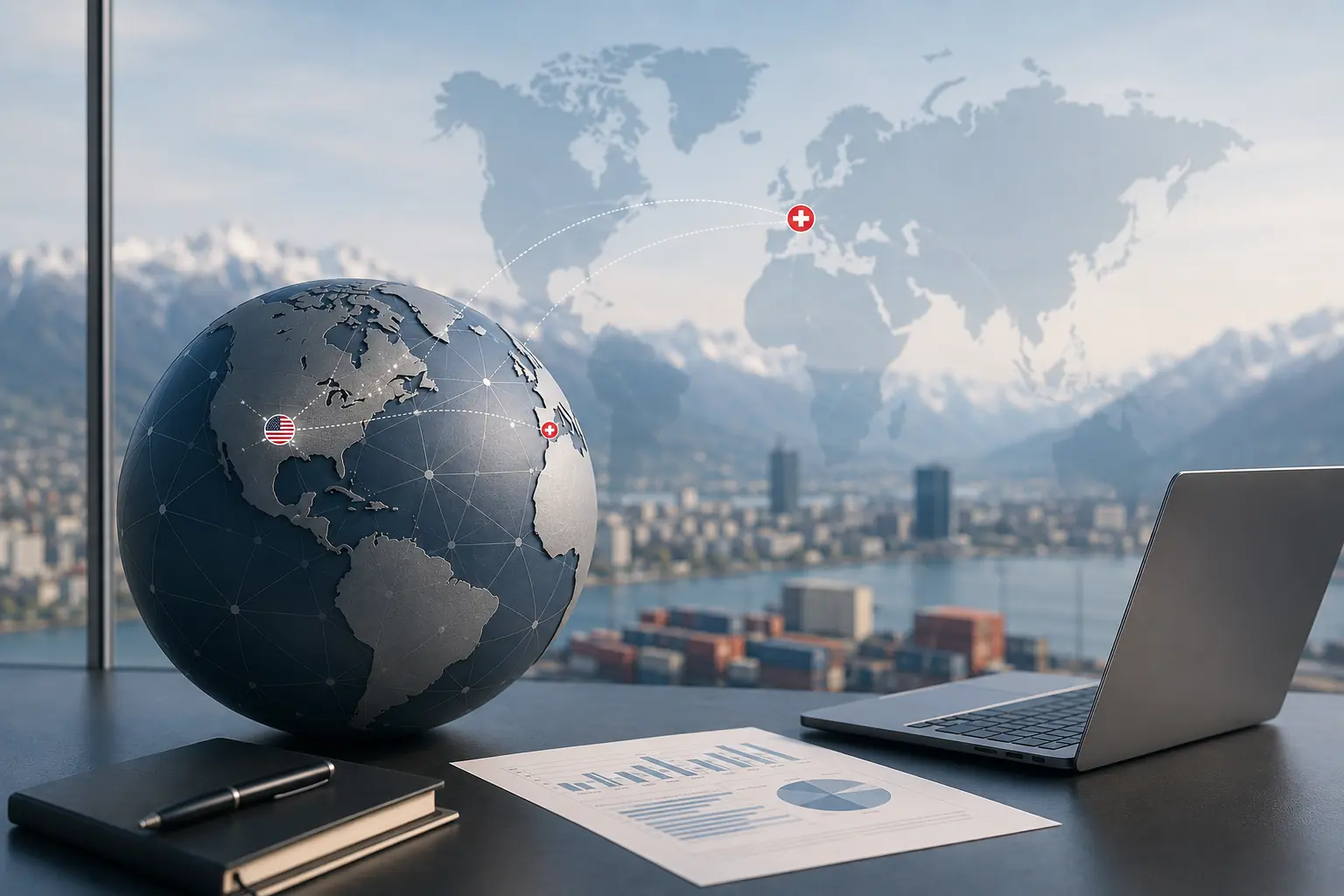
The recent decisions by the United States to introduce new tariff measures on numerous categories of imported products have brought the issue of international trade relations and their potential consequences back to the centre of attention, particularly for economies strongly oriented towards exports, such as Switzerland.
This is an issue that primarily concerns companies exporting to the United States.
Or does it?
In reality, the effects of trade tensions rarely remain limited to companies directly involved in exports. In an increasingly interconnected economy, any change in international trade rules can have an impact throughout the entire value chain, affecting costs, investments, commercial strategies and the ability to plan effectively.
This is why the issue of tariffs deserves a broader reflection.
Not so much in order to understand how tariff measures will evolve, but rather to understand how companies can navigate an economic environment characterised by greater volatility and increasingly rapid change.
The real issue is not only tariffs
When tariffs are discussed, the first consequence that inevitably comes to mind is the increase in costs for exporters.
This is certainly a tangible effect; however, it is not necessarily the one that concerns companies the most today.
Throughout the year, every company makes important decisions: it invests in new projects, hires employees, develops new markets, negotiates contracts with customers and suppliers, and plans its growth.
To do all this effectively, companies need to rely on an environment that is sufficiently predictable.
When the international landscape changes rapidly, it becomes more difficult to estimate margins, plan investments, assess supply costs and define medium- to long-term strategies.
Very often, uncertainty weighs more heavily than the tariff itself.
Companies that do not export may also be affected
It is natural to assume that the issue concerns only companies that sell directly to the US market.
The reality is more complex.
Many Swiss SMEs operate as suppliers to exporting companies, purchase components from abroad or are part of international supply chains.
If a customer changes its production plans, revises its investments or reduces orders due to higher costs, the effects can spread throughout the entire value chain.
Changes in raw material prices, exchange rate fluctuations and a slowdown in international demand can also affect companies that mainly operate on the domestic market.
For this reason, monitoring developments in the international economic environment does not simply mean focusing on foreign markets; it means understanding the context in which a company will have to operate.
Planning becomes a competitive advantage
During periods of greater economic instability, planning becomes even more important.
Not because it allows companies to predict exactly what will happen.
But because it enables them to respond more quickly to change.
Regularly monitoring profitability, reviewing cash flow trends, analysing dependence on specific markets or customers, and assessing alternative scenarios allow companies to make more informed decisions.
The most resilient companies are not necessarily those that manage to avoid every risk.
They are those that identify changes at an early stage and adapt their strategies before the consequences become difficult to manage.
Questions every company should ask itself
Every change in the economic environment is also an opportunity to reflect on one’s business model:
How dependent are we on a specific market?
Is our supply chain sufficiently diversified?
Do we have adequate margins to absorb potential cost increases?
Are our investments sustainable even under less favourable scenarios?
Do we have up-to-date information to make timely decisions?
These questions do not always require immediate action, but they do require awareness.
And it is precisely this awareness that enables companies to face even the most complex periods with greater confidence.
Interpreting economic scenarios is part of modern business advisory
In recent years, the role of fiduciary firms and business advisors has changed significantly. Alongside accounting, tax and administrative matters, there is growing demand for support that helps entrepreneurs understand the economic environment and assess its impact on business management.
International decisions, regulatory changes, market developments and changes in taxation increasingly influence the daily choices of companies.
For this reason, advisory services are no longer limited to ensuring compliance with administrative and tax obligations.
They also mean helping entrepreneurs interpret complex scenarios, assess their potential impact on their business and plan future decisions with greater awareness.
This approach makes it possible to transform uncertainty into an opportunity to strengthen business resilience and competitiveness!
Preparing for change means becoming more competitive
It is difficult to predict how international trade policies will evolve in the coming months. What is clear, however, is that companies will continue to face an environment characterised by frequent changes, interconnected markets and new competitive challenges.
In this context, the ability to plan represents a strategic advantage, because competitiveness does not depend solely on the quality of products or services offered; it also depends on the ability to identify changes quickly, understand their consequences and transform uncertainty into informed decisions.
For Swiss SMEs, the issue of tariffs therefore represents much more than a trade-related matter.
It is a reminder of the importance of understanding the economic environment in which they operate, continuously monitoring its evolution and building strategies that are flexible enough to respond to change.
In this journey, the value of advisory support is measured not only by the management of administrative and tax obligations, but also by the ability to support entrepreneurs in interpreting economic scenarios and planning their decisions.
Because companies that achieve sustainable growth do not simply react to change.
They observe it, understand it and transform it into an opportunity to strengthen their future.
In summary
The new tariff measures introduced by the United States are a sign of an increasingly dynamic and unpredictable international economic environment.
Even when their direct effects concern only part of the business community, their consequences can extend across entire value chains, influencing costs, investments and business strategies.
For Swiss SMEs, it is therefore essential to continuously monitor economic developments, plan decisions carefully and have access to up-to-date information.
In a constantly evolving market, the ability to interpret change is today one of the key drivers of competitiveness.
Let's talk
Does this topic concern your business too? Let's meet.
Half an hour of conversation beats a thousand emails. Chat with us on WhatsApp or set up a meeting: no commitment, no costs.